Overlocker vs Sewing Machine (Serger): Which Do You Need?
A sewing machine joins fabric together using a top thread and a bobbin thread, and it’s the machine you need to build almost any project from scratch.
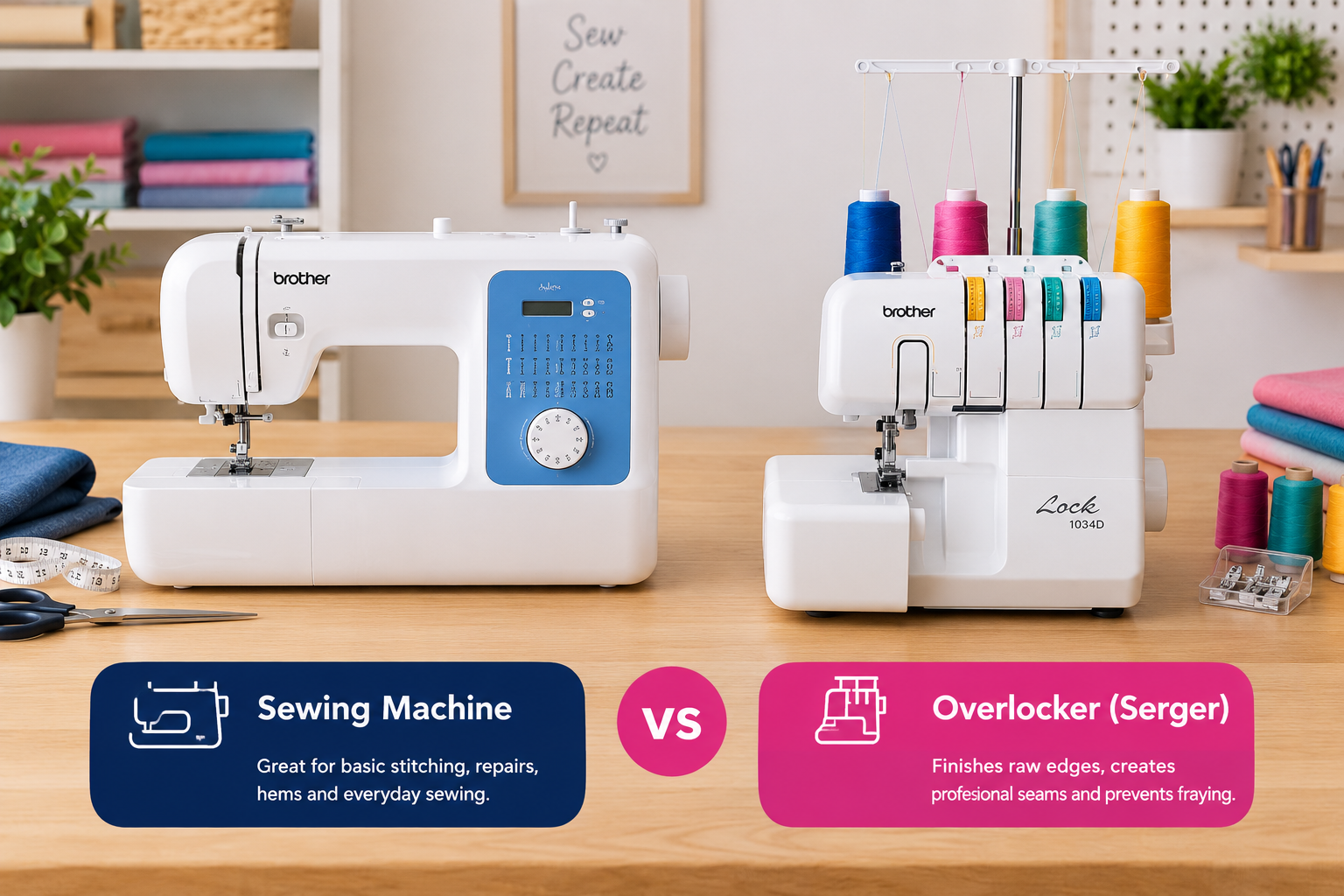
An overlocker called a serger in the US and Canada uses three to five threads and a built-in cutting blade to trim, sew and finish a raw edge in one pass. You need a sewing machine first. An overlocker is something you add later to get faster, more professional-looking seams, especially on knits.
If you’ve stood in the sewing machine aisle at Spotlight or scrolled Lincraft’s website wondering whether you need one machine or two, you’re not alone. This guide walks through exactly what each machine does, when you genuinely need an overlocker, what they cost in Australia, and which models are worth shortlisting so you can spend your money on the right tool the first time.
Affiliate Disclosure: This post contains affiliate links. If you buy through them, HomeNoche may earn a small commission at no extra cost to you. Full details on our Affiliate Disclosure page.
Sewing Machine vs Overlocker vs Serger: Are They the Same Thing?
No confusion needed here a serger and an overlocker are the exact same machine. “Serger” is the term used in the United States and Canada.
“Overlocker” is the term used in Australia, the UK, and much of Europe. If you’re reading an American sewing blog and it mentions a serger, and your local Spotlight or Lincraft catalogue lists overlockers, they’re talking about identical machines.
For the rest of this guide, we’ll use “overlocker” as the primary term (since that’s what you’ll see on Australian shelves and product listings) and note “serger” alongside it for clarity.
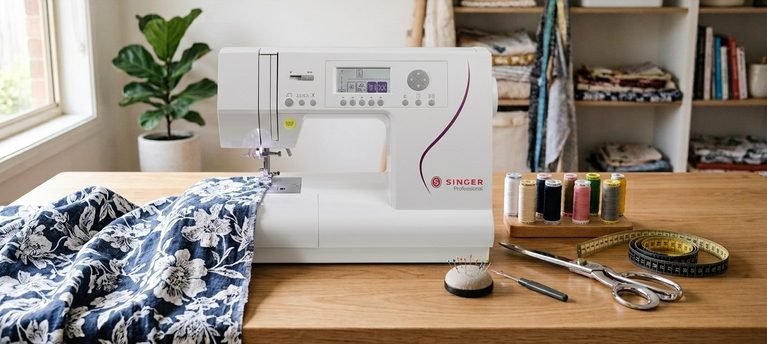
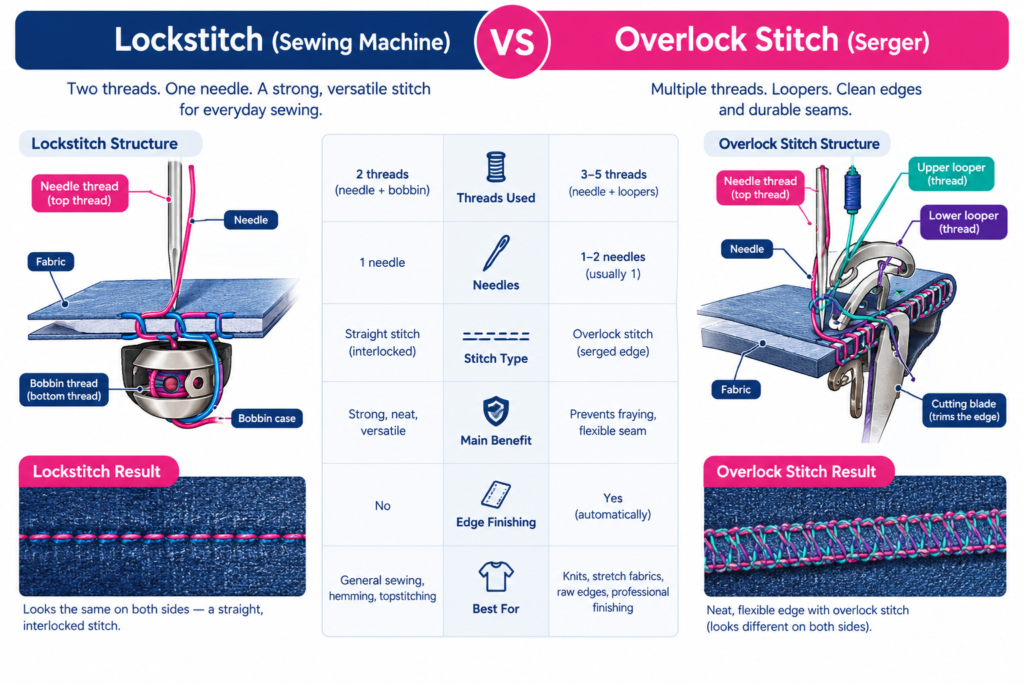
A sewing machine, by contrast, is the general-purpose tool. It uses a needle thread and a bobbin thread locked together underneath the fabric to create a straight, zigzag, or decorative stitch. You can sew a seam anywhere on a piece of fabric down the middle, along an edge, in a curve and you can install zips, sew buttonholes, and quilt layers together. It’s the foundation machine for constructing almost anything.
An overlocker is a specialist. It trims the raw fabric edge with an internal blade and wraps it in an interlocked, stretchy stitch using loopers, a mechanism a sewing machine simply doesn’t have. It can’t sew a buttonhole, install a zip, or stitch through the centre of a fabric panel. What it does extremely well is finish edges quickly, prevent fraying, and handle stretch fabrics with far more give than a standard lockstitch.
How Each Machine Actually Works
The difference comes down to what’s inside each machine.
Feature | Sewing Machine | Overlocker (Serger) |
|---|---|---|
Thread source | Needle thread + bobbin | 3 to 5 thread cones, no bobbin |
Key mechanism | Needle + bobbin hook (lockstitch) | Needle(s) + loopers (overlock stitch) |
Cutting blade | None (built-in) | Yes trims the seam allowance as it sews |
Differential feed | Rare, usually only on high-end models | Standard controls stretch and puckering |
Typical speed | Roughly 300–850 stitches per minute | Roughly 1,300–1,500 stitches per minute |
Stitch library | Dozens to hundreds of stitch options | A handful of overlock, rolled hem, and flatlock stitches |
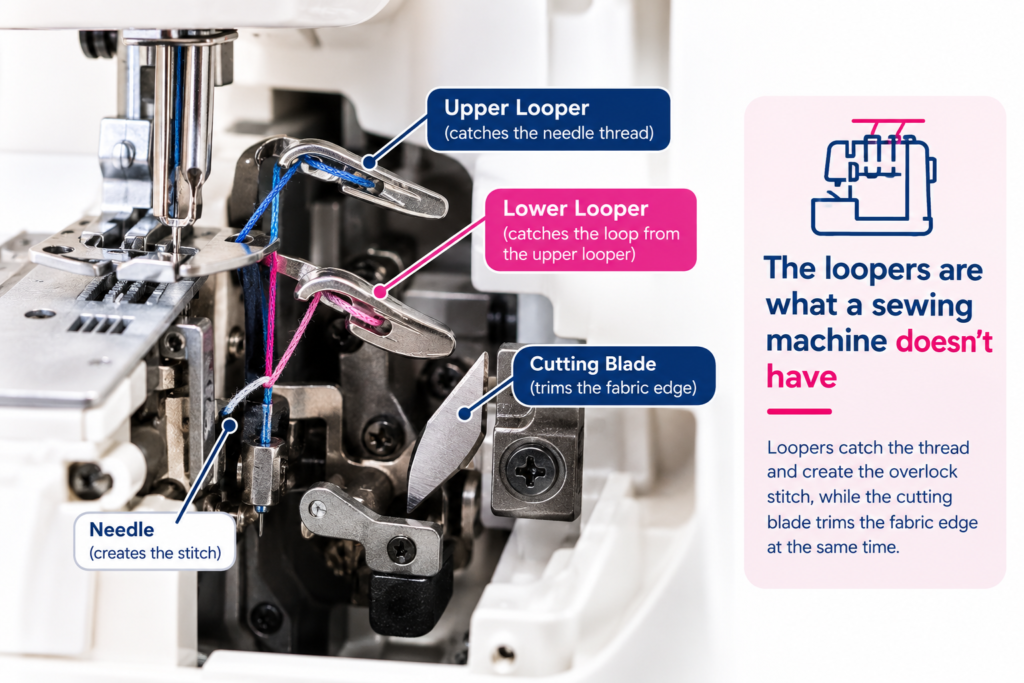
A sewing machine’s bobbin and hook interlock two threads inside the fabric layers, which is what makes a lockstitch strong, flat, and reversible. It’s a slower, more controlled process because you’re usually pivoting corners, backstitching, or matching pattern pieces not running flat-out. (The speed ranges above are typical figures published by manufacturers such as Brother and Janome across their domestic machine ranges, not measurements from independent testing.)
An overlocker’s loopers do something a sewing machine physically cannot they pass threads around the raw edge of the fabric rather than through the middle of it, encasing the cut edge as the blade trims it to a consistent width.
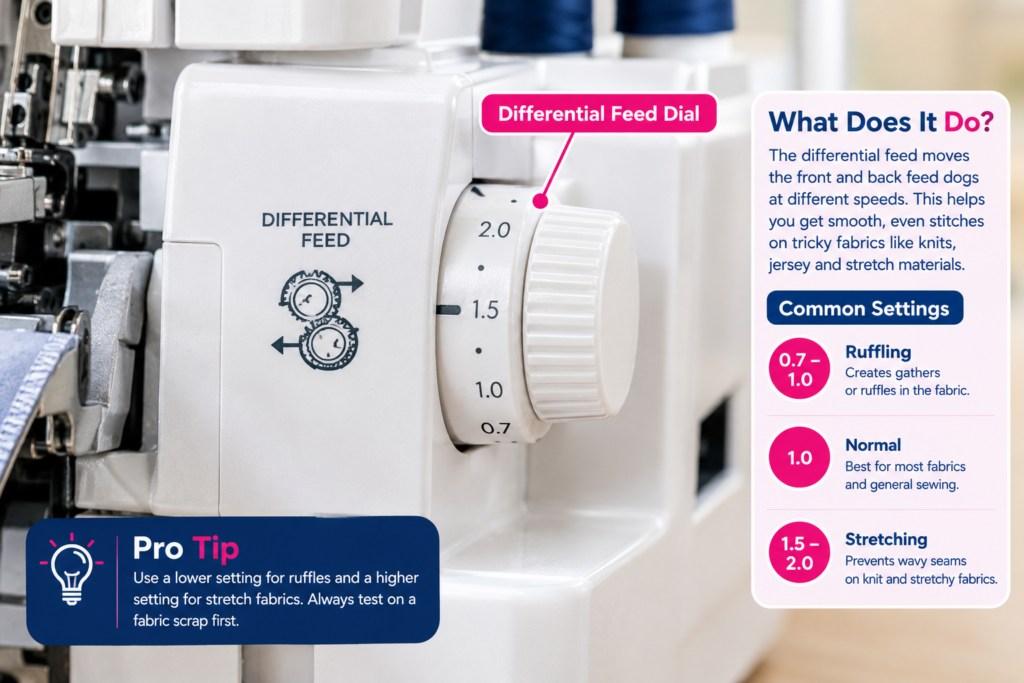
The differential feed of two sets of feed dogs moving at slightly different speeds is the feature that makes this genuinely useful on knits. Turn it up to stop wavy seams on stretchy fabric turn it down to stop puckering on delicate or slippery fabric. Most home sewing machines don’t have this control at all.
Sewing Machine vs Overlocker: Stitch-by-Stitch Comparison
Task | Sewing Machine | Overlocker |
|---|---|---|
Building a garment from a pattern | Excellent | Not possible |
Zips, buttonholes, snaps | Excellent | Not possible |
Straight seams on woven fabric | Excellent | Not designed for this |
Finishing raw edges | Possible (zigzag or overcast foot) | Excellent its main job |
Sewing knits and stretch fabric | Possible with a stretch needle and stitch | Excellent differential feed prevents wave and pucker |
Quilting | Excellent | Not suitable for piecing a quilt top |
Rolled hems on lightweight fabric | Possible, more fiddly | Fast and clean |
Decorative topstitching | Excellent | Very limited |
Do You Need an Overlocker?
Not everyone does and that’s a genuinely useful thing to know before you spend the money.
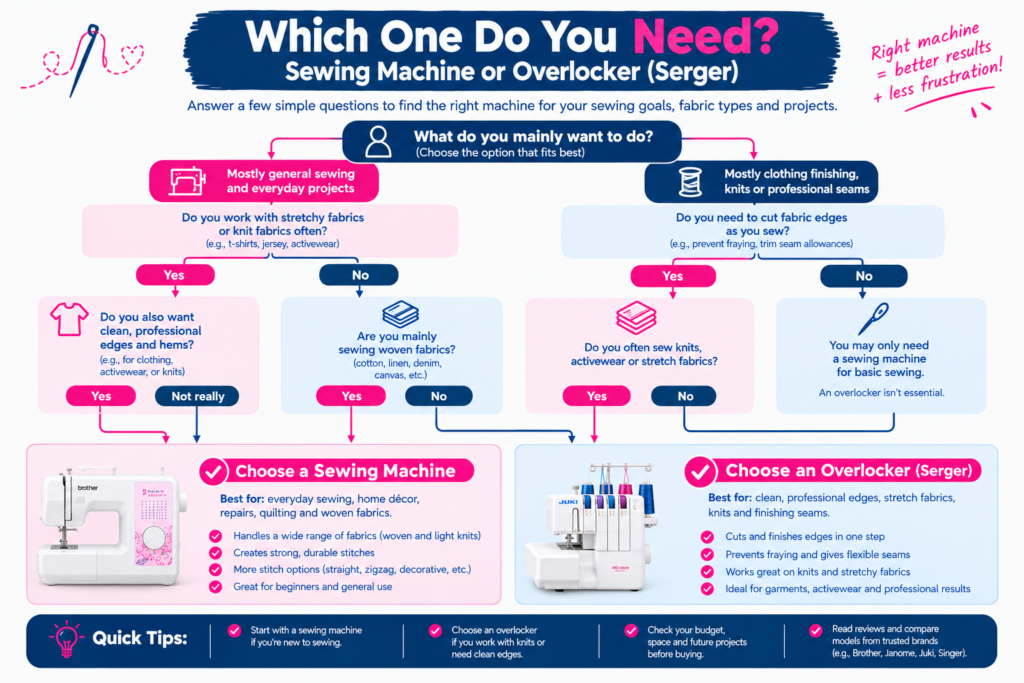
You’ll probably benefit from an overlocker if:
- You sew garments regularly and want a professional, durable finish on the inside seams
- You work with knit or stretch fabric often (t-shirts, activewear, swimwear)
- You’re tired of the extra time zigzag-finishing every seam by hand
- You’re comfortable investing in a second machine and finding storage for it
You probably don’t need one yet if:
- You’re brand new to sewing and still learning your machine
- You mostly do patchwork, quilting, mending, or small craft projects
- Your projects are mainly wovens where a French seam or bias binding gives a perfectly good finish
- Budget or space is tight right now
If you’re mainly making swimwear, activewear, or fitted knit garments, an overlocker earns its keep quickly; the stretch in its stitch is genuinely hard to replicate on a standard lockstitch machine. If you’re quilting or mending, you can put that money toward fabric and notions instead.
Sewing Machine vs Overlocker for Knits
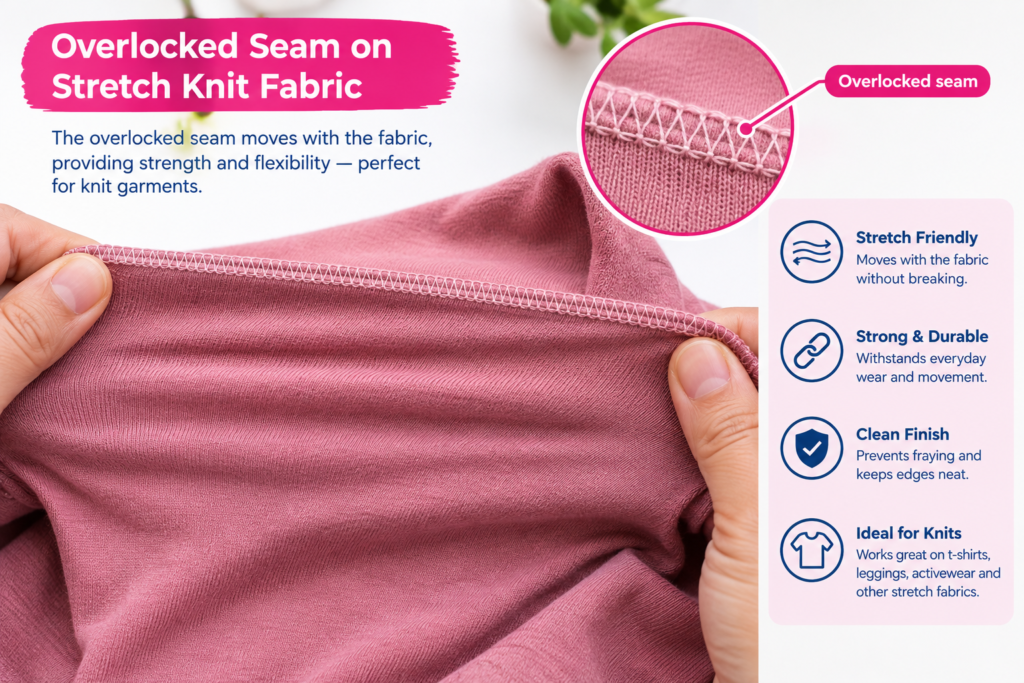
This is where the two machines diverge most clearly. A standard sewing machine can sew knits using a walking foot, a stretch needle, and a stretch or narrow zigzag stitch but the seam has limited give, and it’s easy to end up with skipped stitches or a wavy seam if the fabric isn’t fed evenly.
An overlocker’s differential feed is specifically built to solve this. It gently stretches or eases the fabric as it feeds through, so the finished seam lies flat and moves with the garment instead of popping stitches the first time you sit down in it. That’s why most activewear, swimwear, and jersey-knit patterns are drafted assuming a serged or overlocked seam.
Can You Finish Edges Without an Overlocker?
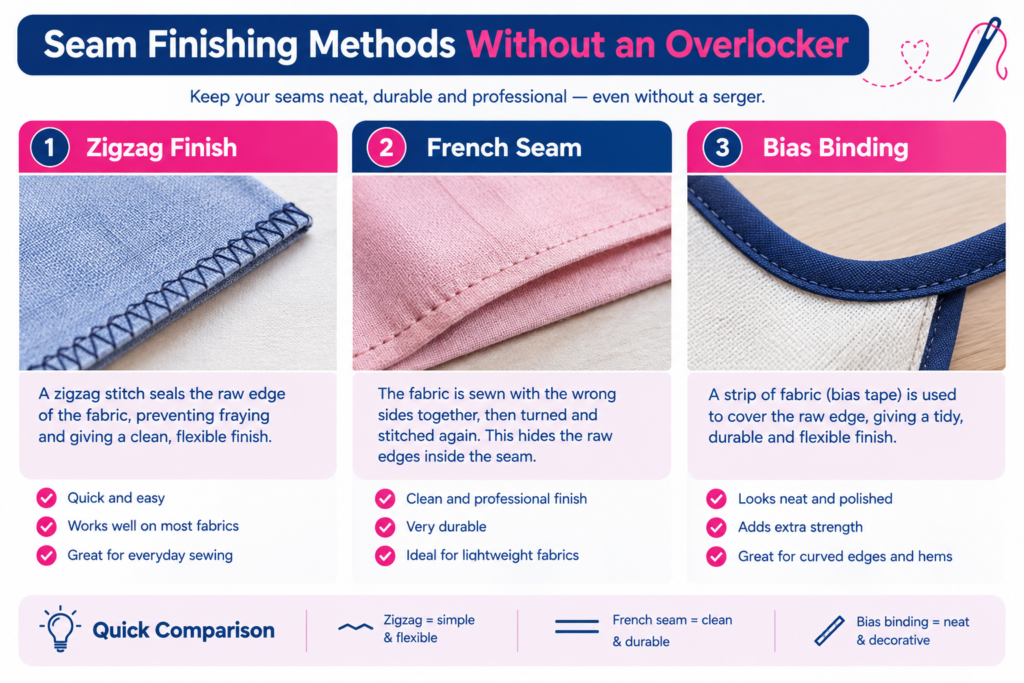
Yes plenty of Australian sewists build entire wardrobes without one. A few reliable options:
- Zigzag stitch: The simplest fix. Sew a medium-width zigzag along the raw edge before or after joining your seam.
- Overcast stitch and foot: Many sewing machines have a dedicated overcast stitch and foot that mimics an overlocked edge more closely than a plain zigzag.
- French seams: Encloses the raw edge entirely inside the seam itself a beautiful finish for lightweight, sheer, or delicate wovens.
- Bias binding: Wraps the raw edge in bias tape, commonly used on unlined jackets and bags.
- Pinking shears: No machine needed at all cutting a zigzag edge with pinking shears reduces fraying on wovens, though it won’t stop it completely.
None of these give you the speed or stretch-friendly finish of a genuine overlocked seam, but they’re completely viable if you’re not ready to buy a second machine yet.
What About Combo Overlocker/Coverstitch Machines?
You’ll see combo machines advertised in Australia most commonly overlocker-and-coverstitch combination units. On paper, one machine that does both looks like the space- and money-saving option. In practice, most experienced sewists steer away from them: switching between overlock mode and coverstitch mode usually means re-threading and re-tensioning the machine, which eats up the time you were trying to save.
If your budget allows, a dedicated overlocker plus a dedicated coverstitch machine (or simply a sewing machine with a stretch/coverstitch-style stitch) tends to be less frustrating long-term than one machine trying to do both jobs.
Buying Guide: What to Look For and What It Costs in Australia
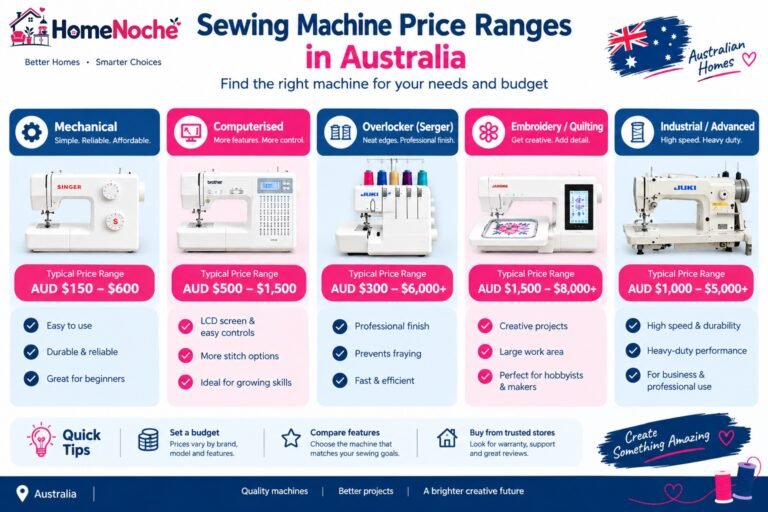
Prices below are approximate AUD ranges based on current Australian retailer listings as of publication; always check GST-inclusive pricing and delivery costs at checkout, as these vary between retailers.
Category | Price Range (AUD) | What You Get |
|---|---|---|
Entry-level sewing machine | $150 – $300 | Mechanical or basic electronic, core stitches, good for learning |
Mid-range sewing machine | $300 – $700 | More stitch options, better build quality, often computerised |
High-end sewing machine | $700 – $3,000+ | Advanced computerised features, embroidery capability, heavy-duty motors |
Entry-level overlocker | $200 – $600 | 3/4-thread capability, manual threading, basic differential feed |
Mid-range overlocker | $600 – $1,500 | Easier threading systems, better tension control, sturdier build |
High-end overlocker | $1,500 – $3,000+ | Air/jet threading, coverstitch functions, industrial-grade speed and durability |
A few things worth knowing before you buy:
- A cheap overlocker can cost you more in frustration than it saves in dollars. Very basic models are often harder to thread, harder to tension correctly, and struggle with heavier fabrics.
- Look for a differential feed knob on any overlocker you’re considering it’s a genuine must-have, not a nice-to-have, if you plan to sew knits.
- Buying from an Australian dealer (rather than a grey-import) usually means local servicing, spare parts, and a warranty that’s enforceable under the Australian Consumer Law’s consumer guarantees worth factoring in even if the sticker price is a little higher.
- Reputable Australian retailers and dealer networks to shortlist from include Spotlight, Lincraft, and authorised Janome, Brother, Husqvarna Viking, Bernina, Pfaff, and Juki dealers.
Storing Your Machine in the Australian Climate
Both machines are more sensitive to Australia’s climate swings than most people expect. In humid coastal and tropical areas (think Queensland, northern NSW, or the Top End), metal internal parts especially an overlocker’s blade and loopers can develop surface rust surprisingly quickly if the machine sits uncovered between uses.
A fitted dust cover, a light coat of sewing machine oil on exposed metal before storage, and keeping the machine off the floor (away from damp) all help. In drier inland or southern regions, the bigger risk is dust and temperature swings in an uninsulated garage or shed, which can affect belt tension and electronics on computerised models over time.
If you’re storing either machine for an extended period over a Christmas break, say a silica gel sachet inside the dust cover and a room-temperature spot indoors will do more for its lifespan than any feature on the machine itself.
Buying Second-Hand in Australia
A genuinely Australian-friendly option: both sewing machines and overlockers hold up well second-hand if they’ve been serviced, and the local market is active. Gumtree, Facebook Marketplace, and local sewing guild noticeboards regularly list well-maintained machines often at a fraction of retail. A few tips if you go this route:
- Ask when the machine was last serviced, and factor in the cost of a service (often $60–$120) if it hasn’t been done recently.
- Test-thread the machine or ask for a video of it running before you commit, if buying remotely.
- Older mechanical machines (particularly vintage Janome, Bernina, and Singer models) are often extremely durable and can be a great-value first machine.
- Second-hand overlockers can be trickier to ask specifically whether the blade is still sharp and whether all the original feet and manual are included, since manuals for older models can be hard to source.
Frequently Asked Questions
About Author

Muhammad Irfan Malhi is Content Researcher at HomeNoche. He researches and writes buying guides for home, kitchen and craft products, drawing on manufacturer specifications, retailer data, and Australian consumer sources to help readers make informed decisions. This guide is based on independent research rather than in-house product testing.